In the American classic, The Great Gatsby, by F. Scott
Fitzgerald, the protagonist, Gatsby, discovers that living a wealthy life can
lead to various misfortunes. Told in first person point-of-view, the author
supports his theme by describing the setting of Long Island, New York, also
known as West Egg, the home of the newly rich, introducing the major conflict
of Gatsby and his monumental amounts of money and his lack of knowledge of how
to use it wisely, and incorporating the literary devices of imagery and archaic
language. Fitzgerald’s purpose is to depict the scenery in the West Egg as well
as introduce the main characters in order to set the tone for the forthcoming
rise in action in the storyline. He creates an affluent mood for an audience of
people interested in the 1920s lifestyle.
Monday, May 13, 2013

Researcher Chapter 5-6
1. The Great Gatsby was during the time of the Prohibition Era which was the time alcohol was illegal no matter what age you were. The book also had Flappers. In the 1920s the term, "Flappers" are used to describe young women especially one who, behaved and dressed in a boldly unconventional manner. The of this book was Myrtle Wilson because she wasn't faithful in having only one partner, instead she had two and kept it a secret and did what she wanted without caring about what others thought about her. This makes her rebellious, to add onto this, she is also married to George Wilson, but is a mistress to Tom Buchanan. Her appearance is also similar to a Flapper's because she has her hair cut into a short bob and her attire consists of wearing short dresses. The Great Gatsby is also connected to materialism, the girls in the book keep wanting more than they already have which then caused them to have an affair with richer men so that they can be wealthy by dating another guy with more money.
Saturday, May 11, 2013
Travel Tracer for Chapters 3 and 4:
Chapter 3 begins at West Egg where Gatsby throws a party , and all of the wealthy individuals come over to celebrate here. Then, as the party ends and the guests leave, Nick also decides to leave back home, where he practically lives next to Gatsby. In Chapter 4, he fun and exciting party environment later transitions to the next beautiful morning when Gatsby picks up Nick to take him to go eat lunch in New York and they go through the valley of ashes. Next, the story moves back to the past; Jordan tells Nick about Daisy's and Gatsby's romance when he was just a lieutenant and she was younger. Jordan explains as much as she can to Nick and then tells him to help Gatsby with a favor to see Daisy without her knowing. This story has a plethora of scenes where the past events are remembered like flashbacks, and then back to reality.
Chapter 3 begins at West Egg where Gatsby throws a party , and all of the wealthy individuals come over to celebrate here. Then, as the party ends and the guests leave, Nick also decides to leave back home, where he practically lives next to Gatsby. In Chapter 4, he fun and exciting party environment later transitions to the next beautiful morning when Gatsby picks up Nick to take him to go eat lunch in New York and they go through the valley of ashes. Next, the story moves back to the past; Jordan tells Nick about Daisy's and Gatsby's romance when he was just a lieutenant and she was younger. Jordan explains as much as she can to Nick and then tells him to help Gatsby with a favor to see Daisy without her knowing. This story has a plethora of scenes where the past events are remembered like flashbacks, and then back to reality.
Wednesday, May 8, 2013
Monday, April 29, 2013
Discussion Director Chapters 3-4
CHAPTER 3
1. What is one of the reasons why Gatsby is so well known in New York?
2. Why was it awkward for Nick at the party and why were their rumors being spread about Gatsby?
3. Explain this quote "He had one of those rare smiles with a quality of eternal reassurance in it, that you may come across four or five times in life."
CHAPTER 4
1. Why was Gatsby pulled over by a cop, and what did he show him? What happens then?
2. What did Gatsby confess to Jordan?
3. Why does Gatsby want Nick to invite Daisy to tea?
1. What is one of the reasons why Gatsby is so well known in New York?
2. Why was it awkward for Nick at the party and why were their rumors being spread about Gatsby?
3. Explain this quote "He had one of those rare smiles with a quality of eternal reassurance in it, that you may come across four or five times in life."
CHAPTER 4
1. Why was Gatsby pulled over by a cop, and what did he show him? What happens then?
2. What did Gatsby confess to Jordan?
3. Why does Gatsby want Nick to invite Daisy to tea?
Friday, April 26, 2013
The Great Gatsby Researcher for Chapters 1 & 2:
East Egg, Long Island: A city in New York in which aristocrats who have always been wealthy live in because they are fully developed and fairly rich. This is where Tom Buchanans lives with his wife Daisy. People living in East Egg are snobby, greedy, and focus a lot more on the material items that cost money.
West Egg. Long Island: A city in New York where developing individuals are working their way up to become someone wealthy. The people that habit West Egg area bit more humble since they have not been accommodated to the material items yet, and this is where Nick lives.
Setting during 1920s: Chapter one takes place in 1922 which was when the "Roaring Twenties" first began where fashion trends began to change, and women began to vote. During this time period, a group of outgoing women, the Flappers, came out to celebrate the minimum freedom they had. Most people during this era thought that the more money owned would be the path towards happiness.
East Egg, Long Island: A city in New York in which aristocrats who have always been wealthy live in because they are fully developed and fairly rich. This is where Tom Buchanans lives with his wife Daisy. People living in East Egg are snobby, greedy, and focus a lot more on the material items that cost money.
West Egg. Long Island: A city in New York where developing individuals are working their way up to become someone wealthy. The people that habit West Egg area bit more humble since they have not been accommodated to the material items yet, and this is where Nick lives.
Setting during 1920s: Chapter one takes place in 1922 which was when the "Roaring Twenties" first began where fashion trends began to change, and women began to vote. During this time period, a group of outgoing women, the Flappers, came out to celebrate the minimum freedom they had. Most people during this era thought that the more money owned would be the path towards happiness.
The Great Gatsby- Vocabulary Enricher/Word Wizard/Illustrator
Chapter 1
1. Levity- Lightness of mind, character, or behavior; lack of appropriate seriousness or earnestness.
2. Feigned- Pretended; sham; counterfeit: feigned enthusiasm.
3. Effeminate- (of a man or boy) having traits, tastes, habits, etc., traditionally considered feminine, as softness or delicacy.
Chapter 2
2. Incessant- adjective
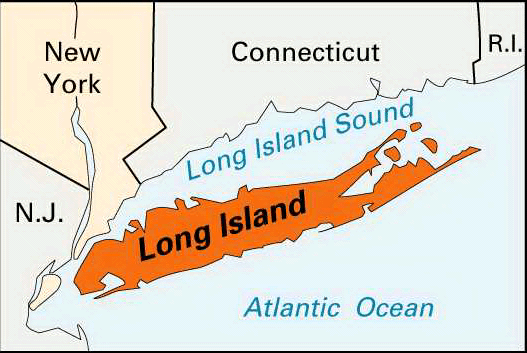
This picture shows the setting of Chapter 1 and two. West Egg and New York.
1. Levity- Lightness of mind, character, or behavior; lack of appropriate seriousness or earnestness.
2. Feigned- Pretended; sham; counterfeit: feigned enthusiasm.
3. Effeminate- (of a man or boy) having traits, tastes, habits, etc., traditionally considered feminine, as softness or delicacy.
Chapter 2
2. Incessant- adjective
continuing without interruption; ceaseless; unending: an incessant noise.
This picture shows the setting of Chapter 1 and two. West Egg and New York.
Thursday, April 25, 2013
The Great Gatsby
Discussion Questions
Chapters 1-2
1.What is the difference between East Egg and West Egg?
2. Please explain and analyze the quote "I hope she'll be a fool-that's the best thing a girl can be in the world, a beautiful little fool."
3.What does the valley of ashes symbolize?
4. What were the major events that occurred within the impromptu party?
Discussion Questions
Chapters 1-2
1.What is the difference between East Egg and West Egg?
2. Please explain and analyze the quote "I hope she'll be a fool-that's the best thing a girl can be in the world, a beautiful little fool."
3.What does the valley of ashes symbolize?
4. What were the major events that occurred within the impromptu party?
Sunday, April 7, 2013
Vocabulary Ch. 14-30
Furrows: a narrow groove made in the ground; especially by plow (channel, pathway)
Phonograph: any sound-reproducing machine using records in the form of cylinders or discs (victrola).
etch ins: to erode a design or message into something, usually with acid
John Rabbit: American rock keyboardist
Gasket: a compressible packing piece of paper, rubber slang: burst out in anger
Babbitt: a bearing or lining with Babbitt metal
Sullenly: showing irritation or ill humor by a gloomy silence or reserve
Shim: a thin slip or wedge of metal, wood, etc. to level out
Piston: a disk or cylinder part tightly fitting and moving within a cylinder, either to compress or move a fluid collected in the cylinder; a pump-like valve
Spool: anything round with other materials like thread
Figgers: ? ? ?
Acquaintanceship:a person with whom one has been in contact but who is not a close friend
Dispossessed:to take away possession of something, esp property; expel
Nebulous:lacking definite form, shape, or content; vague or amorphous
Shafter: tricking or cheating
Hoovervilles: a collection of huts and shacks; edge of city; housing the unemployed during the 1930s
Nondescript:lacking distinct or individual characteristics; having no outstanding features
Gunnysacking: when someone silently collects irritations and slights until "the last straw is placed on them" causing an overblown reaction
Sardonically:characterized by irony, mockery, or derision
Agrarian:of or relating to land or its cultivation or to systems of dividing landed property
Okie: a migrant worker from Oklahoma especially during the Great Depression
Destitute: lacking the means of subsistence; totally impoverished
Ginghams: a medium-weight balanced plain-woven fabric made from dyed cotton or cotton-blend yarn
Boxcar: a completely enclosed freight car
Phonograph: any sound-reproducing machine using records in the form of cylinders or discs (victrola).
etch ins: to erode a design or message into something, usually with acid
John Rabbit: American rock keyboardist
Gasket: a compressible packing piece of paper, rubber slang: burst out in anger
Babbitt: a bearing or lining with Babbitt metal
Sullenly: showing irritation or ill humor by a gloomy silence or reserve
Shim: a thin slip or wedge of metal, wood, etc. to level out
Piston: a disk or cylinder part tightly fitting and moving within a cylinder, either to compress or move a fluid collected in the cylinder; a pump-like valve
Spool: anything round with other materials like thread
Figgers: ? ? ?
Acquaintanceship:a person with whom one has been in contact but who is not a close friend
Dispossessed:to take away possession of something, esp property; expel
Nebulous:lacking definite form, shape, or content; vague or amorphous
Shafter: tricking or cheating
Hoovervilles: a collection of huts and shacks; edge of city; housing the unemployed during the 1930s
Nondescript:lacking distinct or individual characteristics; having no outstanding features
Gunnysacking: when someone silently collects irritations and slights until "the last straw is placed on them" causing an overblown reaction
Sardonically:characterized by irony, mockery, or derision
Agrarian:of or relating to land or its cultivation or to systems of dividing landed property
Okie: a migrant worker from Oklahoma especially during the Great Depression
Destitute: lacking the means of subsistence; totally impoverished
Ginghams: a medium-weight balanced plain-woven fabric made from dyed cotton or cotton-blend yarn
Boxcar: a completely enclosed freight car
Chapters 27-30 Illustrator


Cotton Pickers were wanted, but many workers were being tricked due to the fact that they had to have a sack of their own to put the cotton in. Those who did not have one had to buy i t on credit, which resulted in leaving the workers in even more debt. The Joad family was given a boxcar to live in with another family. Both families relied on the Boxcar due to the fact that a flood began.
Subscribe to:
Posts (Atom)